
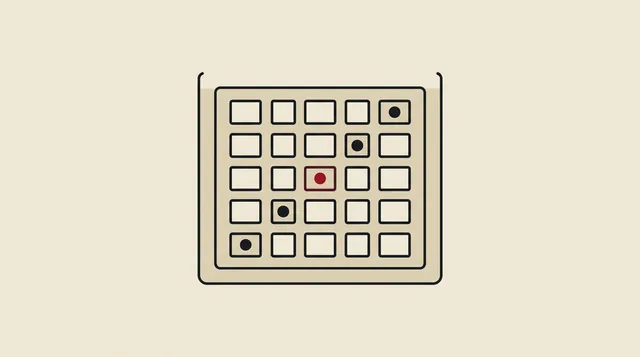
The five grids glowing on a baccarat table or live-dealer screen are record-keeping systems, not crystal balls. They document what has already happened: which side won each hand, how long streaks ran, and whether column patterns in the Big Road repeated or broke. What they cannot do—despite how players lean over them—is change the probability of the next hand. The shoe has no memory.
The Five Grids on the Display
Casino baccarat displays, whether physical or digital, present five distinct scorekeeping systems. Two track hand outcomes directly: the Bead Plate and the Big Road. Three others—the Big Eye Boy, the Small Road, and the Cockroach Road (also called Cockroach Pig)—derive their marks entirely from the structure of the Big Road, not from fresh hand results.
The Bead Plate is the simplest. Each icon represents one hand, recorded in strict sequence. The symbols denote Banker win, Player win, or tie, filling the grid row by row from top left to bottom right. It is a straight chronological ledger.
The Big Road operates differently. It uses red circles for Banker wins and blue circles for Player wins. A new column begins only when the winning side changes. If Banker wins three times, then Player wins once, then Banker wins twice, the Big Road shows a column of three red circles, a column of one blue circle, and a new column of two red circles. Ties appear as small diagonal lines slashed through the most recent circle—not as standalone marks, but as interruptions that do not start new columns.
What the Big Road Records
The Big Road serves as what casino documentation calls the “master board.” Its color scheme inverts ordinary expectation: red means Banker, blue means Player. Each filled circle records a resolved hand. The horizontal axis tracks streaks; the vertical axis tracks their length.
When a tie occurs, the electronic display or manual scoreboard adds a diagonal hash through the last circle placed. Multiple ties mean multiple slashes. The tie does not alter the column sequence—if Banker was winning before the tie, the next Banker win extends that same column. Only a change in winning side forces a new column start.
This structure matters because the three derived roads read their signals from Big Road geometry: column depths, the point at which a new column begins, and whether those patterns echo earlier positions.
What the Derived Roads Record
Big Eye Boy, Small Road, and Cockroach Road do not record hand results. They record whether the Big Road's column structure is behaving consistently or shifting. Each uses red and blue marks, but here the colors mean something entirely different from the Big Road's Banker/Player coding.
Big Eye Boy compares the current pattern in the Big Road with the pattern two columns back. Red indicates the current position echoes that earlier structure—consistency. Blue indicates inconsistency, a break in how columns have been forming. The Small Road performs the same function but looks three columns back. The Cockroach Road extends this logic further, again marking red for continuing trend and blue for change.
The Washington State Gambling Commission's baccarat documentation clarifies this explicitly: on these derived roads, the circles “do not indicate Player or Banker wins.” They mark only whether winning streaks are continuing their previous pattern or deviating from it. A player who sees a cluster of red on Big Eye Boy and interprets it as “Banker is hot” has misunderstood the grid entirely.
What the Roads Cannot Do
The derived roads, in particular, tempt players into pattern-seeking behavior. A column of red marks on Small Road suggests stability; a sudden blue mark suggests disruption. Some players bet that red will continue, others that blue heralds a reversal worth following. Both approaches founder on the same mechanical fact: each hand is an independent event dealt from a shoe that does not adjust based on previous outcomes.
The grids show history. They reveal whether the last twenty hands produced long Banker streaks, choppy alternation, or clustered ties. They do not encode probability for hand twenty-one. The house edge in standard commission baccarat operates regardless of what any road displays. No red column on Big Eye Boy narrows that edge.
Casino operators maintain these displays partly because they slow play. Players who study roads place fewer bets per hour. The documentation from multiple jurisdictions describes the roads as “tracing indicators” and “derived roads,” never as advisory systems. Yet the visual language—red for good, blue for caution—carries implicit suggestion that careful reading yields advantage.
How to Read a Live-Dealer Display
In digital baccarat, whether live-streamed or RNG-based, the display updates automatically. Symbols move from left to right across each grid. The rightmost marks are the most recent; history recedes leftward. A player checking whether a streak is young or mature should scan toward that right edge.
The Bead Plate fills methodically, top-to-bottom then left-to-right. The Big Road snakes through its columns, restarting leftward whenever the winning side changes. The three derived roads begin populating only after enough Big Road columns exist to make comparison possible—Big Eye Boy needs two previous columns, Small Road needs three, Cockroach Road needs the deepest history. Early in a shoe, these grids may show partial data or remain blank.
Some interfaces allow players to toggle roads on and off, or to expand the Big Road to full screen. The underlying mathematics does not change. What changes is how much temptation the player faces to find meaning in random sequence.
The roads can help a player read the history of the shoe. They remain, stubbornly, just a history of the shoe.